Guide
FERPA consent for college students: release vs school form
Last reviewed Nov 19, 2026
Short answer: A FERPA release is a signed consent that lets a school share named education records with the people your 18-year-old names. Many colleges want their own form or student portal setting instead, so a general FERPA release may not be enough. Ask the registrar, bursar and student health office what they accept. Your 18-year-old chooses who is named and signs it.
Educational information, not legal advice. Covered18 is not a law firm. Rules differ by school, and schools and providers may require their own forms.
Before you send a FERPA release, ask the school
Many schools want their own form or portal setting. A general release may not be enough, so a short call or email first can save a round of paperwork.
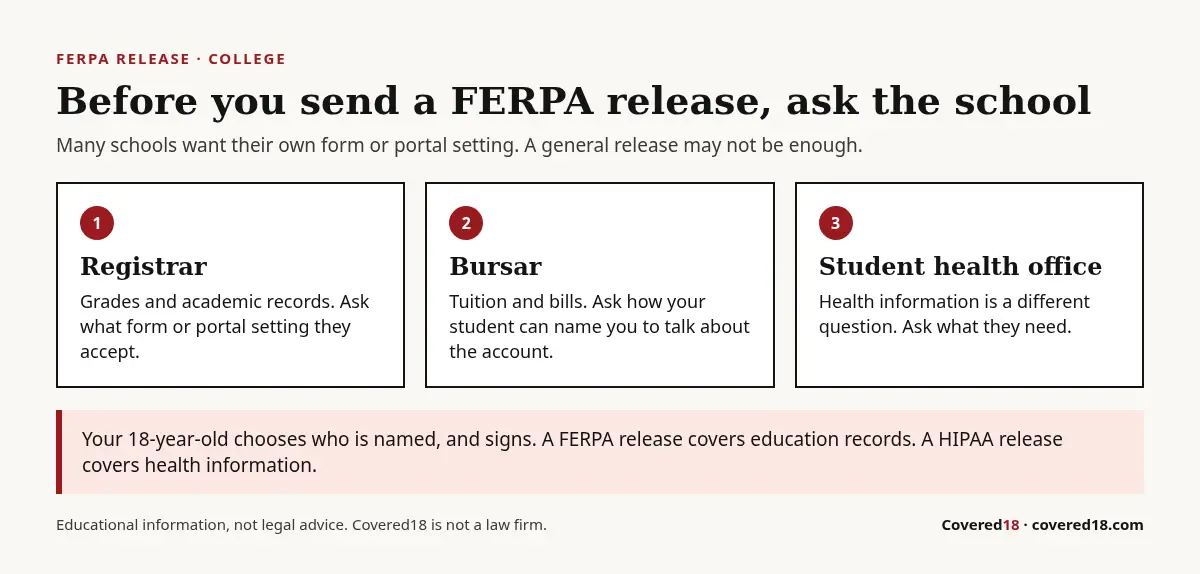
- Registrar. Grades and academic records. Ask what form or portal setting they accept.
- Bursar. Tuition and bills. Ask how your student can name you to talk about the account.
- Student health office. Health information is a different question. Ask what they need.
What changes at 18, or when college starts
FERPA is a federal law about education records. According to the U.S. Department of Education, when a student turns 18, or enters a school after high school at any age, the FERPA rights move from the parents to the student. The Department calls this student an “eligible student.” That is why a college usually wants your student’s permission before it talks with you about grades.
A signed consent can let the school share named records with named people. It is optional, and it is your student’s choice who is named.
The Department also says FERPA lets a school share records with a parent of a student who is a tax dependent, but it does not require the school to. Each school sets its own process, so ask.
FERPA release vs HIPAA release
General information. Details differ by school and provider.
| FERPA release | HIPAA release | |
|---|---|---|
| What it covers | Education records, such as grades and account information | Health information |
| The federal law | FERPA | HIPAA |
| Who signs | Your 18-year-old | Your 18-year-old |
| Who to ask what they accept | The registrar (grades) and the bursar (bills) | The student health office and your student’s doctors |
| Does it unlock the other? | No. It does not unlock medical information. | No. It does not unlock grades. |
For the health side, read HIPAA release vs medical power of attorney.
A simple way to handle it
- Talk it through at the kitchen table: who would be named, and for which records.
- Ask the registrar, bursar and student health office what they accept: their own form, a portal setting, or a general release.
- Your 18-year-old signs the form or completes the school’s portal step.
- Keep a copy, and ask the school how to update or end the consent later.
The Covered18 kit includes a FERPA consent for your state’s kit ($59 one-time, 30-day refund), along with the health care directive, financial power of attorney (or, in some states, a fill-in guide or worksheet) and HIPAA release, a start-here page and a signing guide. Schools may still ask for their own form.
Sources
Sources and official pages:
- U.S. Department of Education: What is FERPA?
- U.S. Department of Education: Can parents view a child’s post-secondary education record?
Links go to the U.S. Department of Education. They are for general information and are not legal advice. For your school’s process, ask the registrar, bursar and student health office.
Questions parents ask
Does my 18-year-old need a FERPA release for college?
Not always, but it is common. At 18, or when a student starts college, the right to see and release education records moves from parents to the student. A signed consent can let the school share named records with named people. It is optional, and many schools ask you to use their own form or portal.
Can I talk to my child's college about grades or tuition bills after they turn 18?
Usually only with your student's permission. Schools use their own process, so ask the registrar (grades) and the bursar (bills) what they accept. For a short, answer-first page on this question, see grades and tuition bills after your child turns 18. According to the U.S. Department of Education, a school may share records with parents of a student who is a tax dependent, but it is not required to. Ask the school.
Is a FERPA release the same as a HIPAA release?
No. FERPA covers education records. HIPAA covers health information. A HIPAA release does not unlock grades, and a FERPA release does not unlock medical information. Ask the student health office what it needs for health information.
Does a public university treat FERPA differently from a private one?
FERPA applies to schools that receive U.S. Department of Education funds, which includes most public and private colleges. Each school still sets its own forms and process. Check the registrar's page or ask them directly.
Is this legal advice?
No. This page is educational information, not legal advice. Covered18 is not a law firm, and using Covered18 does not create an attorney-client relationship. For advice about your family's situation, talk to a lawyer licensed in your state.
Educational information, not legal advice. Covered18 is not a law firm. Schools and providers may require their own forms. Using Covered18 does not create an attorney-client relationship.
$59 one-time, 30-day refund. One state per purchase: you can pick your state before checkout and confirm it on the welcome page after you pay.
All guides · Turning 18 legal documents · HIPAA release vs medical power of attorney · Free forms vs a paid kit · Pricing