A parent’s overview
Turning 18 legal documents: what parents need
Last reviewed Nov 19, 2026
Short answer: most families start with three documents that the 18-year-old signs: a HIPAA release (so doctors can share information with the people named), a health care directive or medical power of attorney (who can make medical decisions if your child can’t), and a financial power of attorney (who can handle money and accounts, or, in some states, a fill-in guide or worksheet). A FERPA consent for school records is an optional fourth, for college students. At 18 your child is a legal adult in most states, and doctors and schools generally need written permission before sharing details with you. Rules differ by state. Educational information, not legal advice. Covered18 is not a law firm.
Start here: most families need 3 forms
A HIPAA authorization (information), a health care power of attorney / advance directive (medical decisions), and a durable financial power of attorney (money). Who must witness or notarize depends on your state — each state page lists the steps. If your child is in school, also consider a FERPA consent. Schools may require their own FERPA form.
HIPAA release
Lets providers talk to the people your 18-year-old names. It is about information, not decisions.
Health care directive
Your state’s version (proxy, surrogate or medical power of attorney) naming who can make medical decisions if your 18-year-old can’t.
Financial power of attorney
Names who can handle money, bills and accounts if your child can’t. The statutory form where the state has one; otherwise, in some states, a fill-in guide or worksheet.
A fourth form, a FERPA consent, can let a school share named records with named people. Many colleges and schools require their own form or portal, so ask the registrar, bursar and student health office what they accept.
The documents side by side
General information. State rules, and each school’s or provider’s own forms, can differ. Age rules differ in a few states.
| Document | What it does | What it does not do | Who signs, and how (varies by state) |
|---|---|---|---|
| HIPAA release (authorization) | Lets providers share health information with the people your 18-year-old names. | Does not let anyone make medical decisions. | Your 18-year-old signs and dates it. HIPAA does not require witnesses or a notary, but a provider may want its own form. |
| Health care directive (medical power of attorney, proxy or surrogate designation) | Names who can make medical decisions if your 18-year-old can’t. | Your child decides while able. Does not let a parent decide for a capable adult. | Your 18-year-old signs. Often two adult witnesses or a notary, depending on the state. |
| Financial power of attorney | Names who can handle money, bills and accounts if your child can’t, or as the document allows. | Not a will. Banks may ask for their own forms. | Your 18-year-old signs. Many states require or suggest a notary, and some require witnesses too. |
| FERPA consent (optional 4th, for college students) | Lets a school share named education records with named people. | Schools may require their own form or portal. | Your 18-year-old signs and dates it. Ask the registrar what the school accepts. |
New to this? Start with the 3 core forms. Read the HIPAA release vs medical power of attorney guide for the most common mix-up, or see free state forms vs a paid kit for an honest look at doing it yourself. Pricing · Find your state
HIPAA vs. a health care power of attorney
This is the distinction families mix up most often. For a side-by-side table, see HIPAA release vs medical power of attorney.
A HIPAA release lets a provider talk to the people your 18-year-old names. It does not give anyone the power to make medical decisions. A health care power of attorney (called a healthcare proxy or surrogate designation in some states) names who can make those decisions if your 18-year-old can’t. While your student is able to decide, they decide. Many families need both documents, and each state has its own rules.
Who signs, and when
Your 18-year-old has to sign for themselves, on or after the 18th birthday. A parent can’t sign for an adult child. Your child also chooses who can step in.
Adulthood starts at 19 in Alabama and Nebraska and at 21 for most things in Mississippi. In Nebraska an 18-year-old can sign both forms; in Alabama an 18-year-old shouldn't sign the health care directive, and in Mississippi the kit's financial item is a worksheet for a lawyer meeting. See your state page. Some papers need a notary or witnesses, and the rules differ by state, which is hard to arrange in a waiting room. Doing it before move-in turns a stressful hospital-waiting-room problem into a family conversation at the kitchen table.
Use the forms and signing rules for the state where your 18-year-old signs, usually where they live. The state finder can help when parent, student and school are in different states.
How to put the paperwork in place
- 1
Understand what changes at 18
Privacy and the right to sign shift to your child. Doctors and schools generally need written permission before they share details with you.
- 2
Start with the forms most families need
HIPAA (information), a health care directive (medical decisions), and a financial power of attorney (money). Add FERPA if your child is in school, and ask the school whether it wants its own form.
- 3
Use your state’s forms and signing rules
Each state has its own paperwork. Pick your state to see the form names and who must witness or notarize.
- 4
Your child signs on or after their 18th birthday
They sign for themselves and choose who can step in. Bring the witness and notary checklist your state requires.
- 5
Share copies, then ask about school and doctor forms
Give copies to the people named in the documents. Hospitals, schools and banks may still ask for their own forms. Review them when something changes, like a new address or school.
More short guides: checklist for an 18-year-old leaving for college, medical records without a HIPAA authorization, grades and tuition bills after 18, and paperwork at 18 if they are not going to college.
Aren’t these forms free?
Many states publish official health care forms for free, and you can absolutely use those. The Covered18 18-and-up Kit is a download ($59 one-time, 30-day refund) that gathers your state’s health care and financial forms (or, in some states, a fill-in guide or worksheet), a HIPAA release and a FERPA consent (four documents in all), plus a start-here page, a plain-English signing and notary guide, and an after-signing checklist, as PDF and Word. One state per purchase. 30-day refund, any reason, for the Covered18 fee (not notary or third-party costs).
Educational information, not legal advice. Covered18 is not a law firm. For advice about your situation, talk to a licensed attorney in your state.
Want the forms in one kit? The Covered18 18-and-up Kit is $59 one-time, 30-day refund, for every state and DC. You can pick your state before checkout and confirm it on the welcome page after you pay.
Buy the kit · $59$59 one-time, 30-day refund
See your state
FERPA release vs your school’s own form
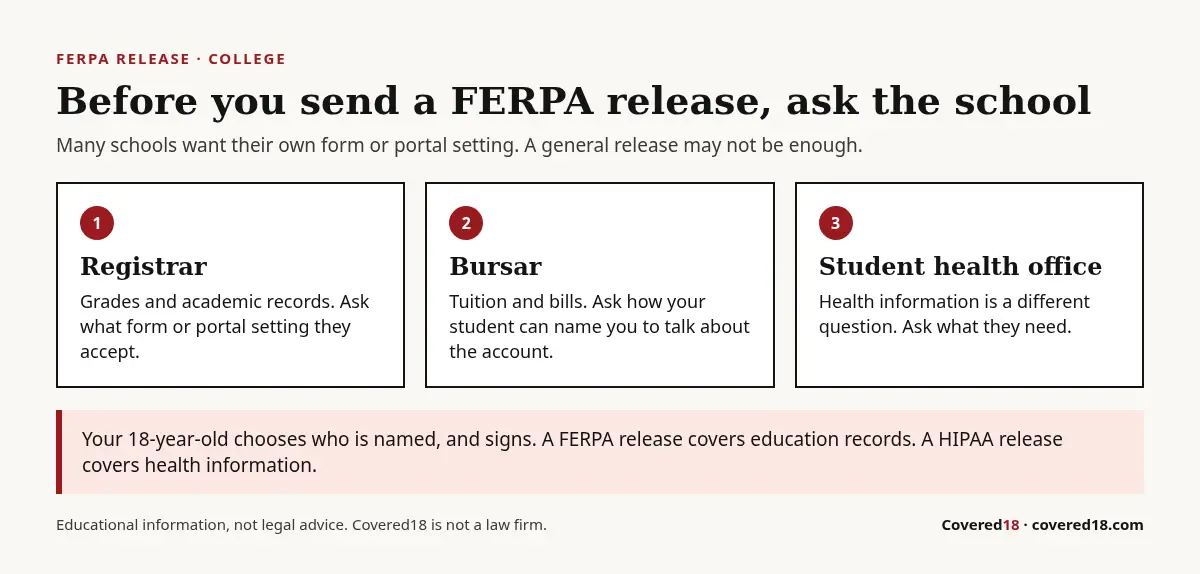
A FERPA release is a signed consent that lets a school share named education records with the people your 18-year-old names. Many colleges want their own form or student portal setting instead, so a general FERPA release may not be enough. Ask the registrar, bursar and student health office what they accept. Your 18-year-old chooses who is named and signs it.
For more, read our guide: FERPA consent for college students: release vs school form.
Key terms in one line
- HIPAA release: A signed permission that lets a doctor or hospital share your 18-year-old's health information with the people they name. It does not give decision power.
- Medical power of attorney: A document that names who can make medical decisions if your 18-year-old can't. Also called a health care directive, proxy or surrogate designation.
- Health care proxy: Another name, used in some states, for the person named to make medical decisions if the signer can't.
- Financial power of attorney: A document that names who can handle money, bills and accounts for your 18-year-old if they can't, or as the document says.
- FERPA release: A signed consent that lets a school share named education records with named people. Schools may want their own form. Read the FERPA guide.
- Age of majority: The age a person becomes a legal adult. It is 18 in most states, 19 in Alabama and Nebraska, and 21 for most things in Mississippi.
Educational information, not legal advice. Covered18 is not a law firm.
Sources
Sources and official pages:
- HHS: Family members and friends (HIPAA)
- HHS: Personal representatives (HIPAA)
- U.S. Department of Education: What is FERPA?
- U.S. Department of Education: Can parents view a child’s post-secondary education record?
General information from the U.S. Department of Health and Human Services and the U.S. Department of Education. Not legal advice.
Questions parents ask
What legal documents does my child need at 18?
Most families start with three forms: a HIPAA authorization so doctors can share information with the people your child names; a health care power of attorney or advance directive naming who can make medical decisions if your 18-year-old can't; and a durable financial power of attorney for money, bills and accounts. If your child is in school, a FERPA consent can let the school share named records with named people, though many schools want their own form. Your 18-year-old signs and chooses who can step in. Educational information, not legal advice. Covered18 is not a law firm.
Is a HIPAA release the same as a health care power of attorney?
No. A HIPAA release lets a provider talk to the people your 18-year-old names. It is about information. A health care power of attorney (called a proxy or surrogate designation in some states) names who can make medical decisions if your 18-year-old can't. While your student is able to decide, they decide. Many families need both documents, and each state has its own rules.
Does my college student need a healthcare proxy?
A healthcare proxy, health care power of attorney, or advance directive is the document that names who can make medical decisions if your student can't. A HIPAA release alone does not give that authority. Your student has to sign for themselves, on or after the 18th birthday (adulthood starts at 19 in Alabama and Nebraska and at 21 for most things in Mississippi; a Nebraska 18-year-old can sign both forms, while in Alabama an 18-year-old shouldn't sign the health care directive). Witness and notary rules depend on the state. Schools, hospitals and banks may also ask for their own forms.
What is a FERPA release for an 18-year-old?
FERPA is the federal law on education records. At 18, or when a student starts college, the rights to see and release those records move from parents to the student. A signed consent can let a school share named records with named people, but schools often want their own form or portal. Ask the registrar, bursar and student health office what they accept.
Who has to sign these forms?
Your 18-year-old signs for themselves, on or after the 18th birthday, and chooses who can step in. A parent can't sign for an adult child. Some documents need a notary or witnesses, and the rules differ by state.
Aren't these forms free?
Many states publish official health care forms for free, and you can use those. Covered18 is a paperwork kit ($59 one-time, 30-day refund) that adds the HIPAA and FERPA forms, your state's witness and notary rules in plain English, and an after-signing checklist, in one download. Educational information, not legal advice. Covered18 is not a law firm.
Do we need all four documents?
Not necessarily. Most families start with three: a HIPAA release, a health care directive, and a financial power of attorney (or, in some states, a fill-in guide or worksheet). A FERPA consent is an optional fourth, mainly for college students, and many schools want their own form. Educational information, not legal advice.
What if my student goes to college in another state?
Signing rules follow the state where your student signs, usually where they live. One state's health care directive does not always work in another, so ask the school, the provider and, if you are unsure, a lawyer which documents to have for each state. Covered18 is one state per purchase, and our state finder can help when parent, student and school are in different states.
Does a HIPAA release give me the right to make medical decisions for my 18-year-old?
No. A HIPAA release only lets a provider share health information with the people your 18-year-old names. It does not give anyone the power to decide. A medical power of attorney (health care directive) is the document that names a decision-maker if your 18-year-old can't decide.
Does my 18-year-old need a FERPA release for college?
Not always, but it is common. At 18, or when a student starts college, the right to see and release education records moves from parents to the student. A signed consent can let the school share named records with named people. It is optional, and many schools ask you to use their own form or portal. See our FERPA guide.
Can I talk to my child's college about grades or tuition bills after they turn 18?
Usually only with your student's permission. Schools use their own process, so ask the registrar (grades) and the bursar (bills) what they accept. According to the U.S. Department of Education, a school may share records with parents of a student who is a tax dependent, but it is not required to. Ask the school.
Is a FERPA release the same as a HIPAA release?
No. FERPA covers education records. HIPAA covers health information. A HIPAA release does not unlock grades, and a FERPA release does not unlock medical information. Ask the student health office what it needs for health information.
Does a public university treat FERPA differently from a private one?
FERPA applies to schools that receive U.S. Department of Education funds, which includes most public and private colleges. Each school still sets its own forms and process. Check the registrar's page or ask them directly.
What does each document in the Covered18 kit do, and who signs?
A HIPAA release lets providers talk to the people your 18-year-old names; it is about information, not decisions. A health care directive names who can make medical decisions if your child can't. A financial power of attorney names who can handle money, bills and accounts (in some states, a fill-in guide or worksheet instead of a form). A FERPA consent lets a school share named records. Your 18-year-old signs; a parent can't sign for them. The kit is $59 one-time, 30-day refund. Age rules differ in a few states. Educational information, not legal advice.
More guides
- HIPAA release vs medical power of attorney (health care directive) — what each one does, side by side
- FERPA consent for college students: release vs school form — what to ask the registrar, bursar and student health office
- Free state forms vs a paid kit: an honest comparison — when free official forms are enough
- Covered18 vs Mama Bear Legal Forms vs LegalGEN vs free state forms — a sourced comparison, including free official forms
- Turning-18 paperwork as a winter break gift — a calm plan for signing at home over break
- All guides
Find your state’s forms
Each state page lists that state’s health care and financial forms and how to sign them. Educational information, not legal advice.
- Alabama
- Alaska
- Arizona
- Arkansas
- California
- Colorado
- Connecticut
- Delaware
- District of Columbia
- Florida
- Georgia
- Hawaii
- Idaho
- Illinois
- Indiana
- Iowa
- Kansas
- Kentucky
- Louisiana
- Maine
- Maryland
- Massachusetts
- Michigan
- Minnesota
- Mississippi
- Missouri
- Montana
- Nebraska
- Nevada
- New Hampshire
- New Jersey
- New Mexico
- New York
- North Carolina
- North Dakota
- Ohio
- Oklahoma
- Oregon
- Pennsylvania
- Rhode Island
- South Carolina
- South Dakota
- Tennessee
- Texas
- Utah
- Vermont
- Virginia
- Washington
- West Virginia
- Wisconsin
- Wyoming
Please read. Educational information, not legal advice. Covered18 is not a law firm. State rules differ; schools and providers may require their own forms. Using Covered18 does not create an attorney-client relationship.