Guide
HIPAA release vs medical power of attorney (health care directive)
Last reviewed Nov 19, 2026
Short answer: A HIPAA release lets doctors share your 18-year-old's health information with the people they name. A medical power of attorney (also called a health care directive, proxy or surrogate designation) names someone who can make medical decisions if your 18-year-old can't. One is about information, the other is about decisions. Your 18-year-old chooses who is named and signs both. Most families set up both, and your student can change or cancel either one later.
Educational information, not legal advice. Covered18 is not a law firm. Rules differ by state, and schools and providers may require their own forms.
Side by side
General information. The details differ by state and by provider, so check the form and your state’s rules.
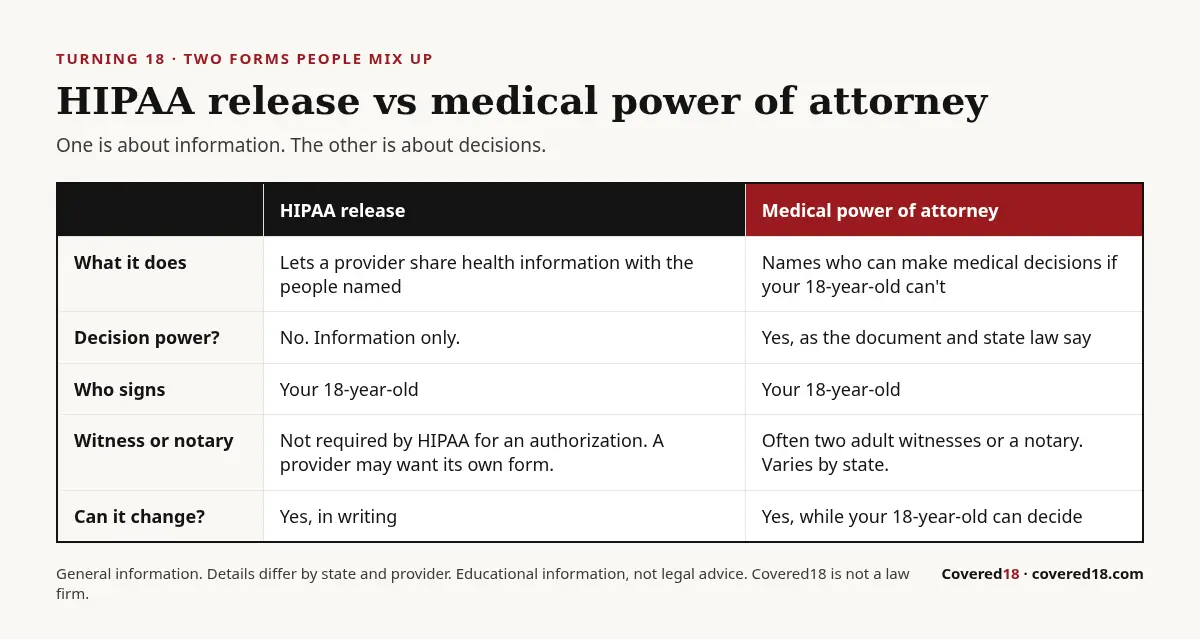
| HIPAA release (authorization) | Medical power of attorney (health care directive) | |
|---|---|---|
| What it does | Lets a provider share health information with the people the release names. | Names an agent (a proxy or surrogate in some states) who can make medical decisions if your 18-year-old can’t. |
| Does it give decision power? | No. It is about information only. | Yes, within the document and your state’s law. The document and the law say when it starts. |
| Access to records | As the release says: which information, who may receive it, and when the release ends. | Often, for information relevant to the agent’s decisions. HHS treats the agent as a “personal representative” for that purpose. Many people also sign a release for everyday use. |
| Where the rule comes from | Federal HIPAA Privacy Rule (45 CFR 164.508). | State law. The name and the rules differ by state: advance directive, proxy, surrogate designation or medical power of attorney. |
| Who signs | Your 18-year-old, on or after the 18th birthday. A parent can’t sign for an adult child. | Your 18-year-old, on or after the 18th birthday. |
| Witnesses or notary | HIPAA does not require them for an authorization. A provider may want its own form. | Often two adult witnesses or a notary. Varies by state. |
| Can it be changed? | Yes. An authorization must tell the signer how to revoke it in writing. | Yes. While your student can decide, they decide and can change or cancel it. State rules say how. |
| Everyday example | A parent calls the student health center about an appointment or a bill. | Your student is unconscious or can’t speak for themselves and a medical decision is needed. |
What HIPAA already lets doctors do, and why a release still helps
Federal HIPAA rules protect your 18-year-old’s health information. According to HHS, the Privacy Rule does not require a provider to share information with family or friends unless they are the person’s personal representative. It does allow a provider to share relevant information with family or friends who are involved in the person’s care if the person agrees or does not object, or, when the person is absent or can’t agree, if the provider decides in its professional judgment that sharing is in the person’s best interest.
That leaves room for judgment calls, and offices handle them differently. A signed HIPAA release is a clear, written permission that names who may receive information. It also has limits: it describes what can be shared and who may receive it, it ends on a date or event, and your 18-year-old can revoke it in writing. A release by itself does not give anyone the power to make decisions.
What a medical power of attorney (health care directive) does
This document names an agent, sometimes called a proxy, surrogate or health care representative, who can make medical decisions if your 18-year-old can’t. The name of the form and the rules for it are set by each state. While your student is able to decide, they decide.
HHS treats a person who can make health care decisions for someone under a health care power of attorney as that person’s “personal representative,” which generally lets them receive the health information relevant to those decisions. The document may say when the agent’s authority starts, and your state’s law fills in the rest.
Without a signed document, many states have default rules for who can speak for an adult who can’t decide. Those rules differ widely, and they may not name the person your family would choose, so many families put a directive in place instead of relying on the defaults.
Which one do you need?
- You want doctors, the student health center or billing offices to be able to talk with you: a HIPAA release.
- You want someone named to make medical decisions if your student can’t: a health care directive or medical power of attorney.
- Most families: both. Some state directive forms include HIPAA wording, and providers may still ask for their own release form, so check the form and ask the provider.
Start with the 3 core forms
If you are doing this over one evening, start with three documents: a health care directive, a HIPAA release, and a financial power of attorney (or, in some states, a fill-in guide or worksheet). A FERPA consent for school records is an optional fourth for college students; schools often want their own form. Each state page lists the signing steps, including who must witness or notarize, and our state finder helps when home, school and the signing place are in different states.
See pricing and what you get, or read the overview Turning 18 legal documents: what parents need.
Common mix-ups
- “A HIPAA release lets us make medical decisions.” It doesn’t. It lets named people receive information.
- “I’m the parent, so I can sign for my 18-year-old.” A parent can’t sign for an adult child. Your student signs.
- “One form covers every provider and school.” Hospitals, schools and banks may ask for their own forms, so ask what they accept.
- “Free forms are enough.” For some families they are. See Free state forms vs a paid kit: an honest comparison.
Key terms in one line
- HIPAA release: A signed permission that lets a doctor or hospital share your 18-year-old's health information with the people they name. It does not give decision power.
- Medical power of attorney: A document that names who can make medical decisions if your 18-year-old can't. Also called a health care directive, proxy or surrogate designation.
- Health care proxy: Another name, used in some states, for the person named to make medical decisions if the signer can't.
- Financial power of attorney: A document that names who can handle money, bills and accounts for your 18-year-old if they can't, or as the document says.
- FERPA release: A signed consent that lets a school share named education records with named people. Schools may want their own form. Read the FERPA guide.
- Age of majority: The age a person becomes a legal adult. It is 18 in most states, 19 in Alabama and Nebraska, and 21 for most things in Mississippi.
Educational information, not legal advice. Covered18 is not a law firm.
Sources
Sources and official pages:
- HHS: Family members and friends (HIPAA)
- HHS: Personal representatives (HIPAA, for individuals)
- HHS: Personal representatives (guidance for professionals)
- HHS FAQ: Does HIPAA allow a provider to communicate with family, friends or others involved in care?
- HHS: Summary of the HIPAA Privacy Rule (authorizations)
- 45 CFR 164.508, uses and disclosures for which an authorization is required (eCFR)
- 45 CFR 164.510(b), disclosures to people involved in care (eCFR)
- 45 CFR 164.502(g), personal representatives (eCFR)
- CaringInfo (National Alliance for Care at Home): free advance directive forms for each state
- American Bar Association: Pick the right power of attorney instrument
Links go to the U.S. Department of Health and Human Services, the eCFR, a national nonprofit and the American Bar Association. They are for general information and are not legal advice. For your state’s rules, see your state page or ask a lawyer licensed in your state.
Questions parents ask
Is a HIPAA release the same as a medical power of attorney?
No. A HIPAA release (authorization) lets a provider share your 18-year-old's health information with the people the release names. A medical power of attorney, also called a health care directive, proxy or surrogate designation depending on the state, names someone who can make medical decisions if your 18-year-old can't. One is about information, the other is about decisions. Many families sign both. Educational information, not legal advice.
Can a parent see an 18-year-old's medical information without a release?
Often not without the adult's permission. HHS explains that the HIPAA Privacy Rule does not require a provider to share information with family or friends unless they are the patient's personal representative, but it does allow a provider to share relevant information with family involved in the patient's care if the patient agrees or does not object, or, if the patient is absent or unable to agree, when the provider decides in professional judgment that sharing is in the patient's best interest. Practices differ, and many offices ask for a signed form, so a written release removes the guesswork.
Does a medical power of attorney give my child's agent access to medical records?
Often, for the information relevant to the decisions the agent is making. HHS treats a person who can make health care decisions for an individual under a health care power of attorney as that individual's personal representative for related health information. But the agent's authority may begin only when the person can't decide, and the document's wording and state law matter. Many families also sign a HIPAA release so named people can talk with providers right away.
Does my college student need both documents?
Many families choose both: the HIPAA release for day-to-day information, and the health care directive for the rare case where the student can't speak for themselves. Neither is required by law, and each state has its own rules for witnesses and notaries. Schools, hospitals and campus health centers may also ask for their own forms.
Can a parent sign these for an 18-year-old?
No. At 18 your child is a legal adult in most states, so your child has to sign for themselves, on or after the 18th birthday. While your student is able to decide, they decide, and they can change or cancel the documents later. Age rules differ in a few states, so check your state page.
Do these documents need a notary or witnesses?
It depends on the document and the state. HIPAA itself does not require witnesses or a notary for an authorization, though a provider may use its own form. Health care directives and medical powers of attorney often require two adult witnesses or a notary, and the rules vary by state. Our state pages list the signing steps for each state.
Is this legal advice?
No. This page is educational information, not legal advice. Covered18 is not a law firm, and using Covered18 does not create an attorney-client relationship. For advice about your family's situation, talk to a lawyer licensed in your state.
Does a HIPAA release give me the right to make medical decisions for my 18-year-old?
No. A HIPAA release only lets a provider share health information with the people your 18-year-old names. It does not give anyone the power to decide. A medical power of attorney (health care directive) is the document that names a decision-maker if your 18-year-old can't decide.
Who signs a HIPAA release or medical power of attorney for an 18-year-old?
The 18-year-old signs, on or after the 18th birthday. A parent can't sign for an adult child. Adulthood starts later in a few states (19 in Alabama and Nebraska, and 21 for most things in Mississippi), so check your state page. Witness or notary rules for a medical power of attorney vary by state.
Can my 18-year-old change or cancel these documents?
Yes. Your 18-year-old can change or cancel either document while able to decide, following the signing and revoking rules that apply. That is why the 18-year-old chooses who is named, and talking it through at the kitchen table matters.
Educational information, not legal advice. Covered18 is not a law firm. State rules differ; schools and providers may require their own forms. Using Covered18 does not create an attorney-client relationship.
$59 one-time, 30-day refund. One state per purchase: you can pick your state before checkout and confirm it on the welcome page after you pay.
All guides · Free forms vs a paid kit · Turning 18 legal documents · FERPA consent for college students · Medical records without a HIPAA authorization · Pricing