Alabama power of attorney, HIPAA & FERPA forms at 18
Last reviewed Nov 2026
What to sign, who needs to be there, and what to do after. Your 18-year-old chooses who can step in.
Start with the 3 core forms: about one evening, step by step, with a 30-day refund.
- Health care directive: medical decisions
- HIPAA release: so doctors can talk to you
- Financial POA: money and accounts
FERPA consent is an optional 4th, for college students.
How signing works in Alabama
In Alabama: health care — Two adult witnesses watch your child sign, then sign too. Financial — Your child signs. A notary isn't required, but we suggest one. HIPAA and FERPA — Your child signs and dates each one. No witnesses or notary needed. Schools may require their own FERPA form.
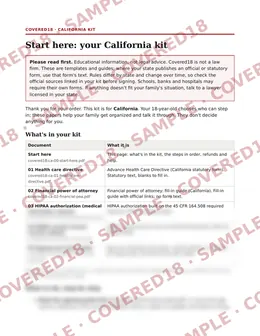
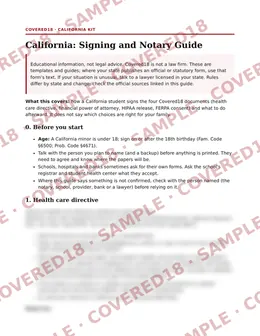
Sample pages (California kit shown, watermarked)
Buy the Alabama kit · $59✓ $59 one-time, 30-day refundTurning 18 in Alabama: the short answer
In short: In Alabama, adulthood starts at 19, so an 18-year-old shouldn't sign the Alabama advance directive, and the age rule for the financial power of attorney is unclear. A FERPA consent (applies at 18) and a HIPAA release (providers may or may not honor it; it isn't decision authority) don't depend on that rule. Schools may require their own FERPA form. Educational, not legal advice.
In Alabama, the legal age of adulthood is 19 (Ala. Code §26-1-1). The advance directive law defines an adult as 19 or older (§22-8A-3), so an 18-year-old shouldn't sign the Alabama advance directive.
At 18 you can still do the parts that don't depend on that rule: a FERPA consent (a federal rule that applies at 18) and a HIPAA release, which providers may or may not honor for an 18-year-old in Alabama.
The Alabama kit covers four documents: the Alabama Advance Directive for Health Care (for someone 19 or older), which names who can make medical choices if your child can't; the Alabama Power of Attorney form (the age rule for an 18-year-old is unclear), which names who can handle money, bills and accounts; a HIPAA release, which lets doctors talk to the people your child names; and a FERPA consent, which lets the college share records like grades or bills, plus a start-here page and a signing guide that explains the age rule.
- Age warning
- In Alabama, an 18-year-old shouldn't sign the health care directive until the 19th birthday (Ala. Code §22-8A-3). The financial form's age rule for an 18-year-old is unclear: ask an Alabama lawyer or wait until 19.
- Health care form
- Two adult witnesses watch your child sign, then sign too. Witnesses must be 19 or older.
- Financial form
- Your child signs. A notary isn't required, but we suggest one. Banks are more likely to accept it.
- HIPAA & FERPA
- Your child signs and dates each one. No witnesses or notary needed.
Educational information, not legal advice. Covered18 is not a law firm.
Get the free turning-18 checklist
A short, printable list of the forms families usually sign at 18, what to bring on signing day, and what to do after, plus a link to Alabama’s signing rules. Free PDF.
⚑ Alabama: adulthood starts at 19
In Alabama, the legal age of adulthood is 19 (Ala. Code §26-1-1(a)), and the advance directive law defines an adult as 19 or older (§22-8A-3(1)). An 18-year-old shouldn't sign the Alabama advance directive: the form itself says the signer is "at least 19 years old." For the financial power of attorney the age rule is unclear. Alabama adulthood starts at 19, but §26-1-1(f) lets an unemancipated 18-year-old of sound mind enter a binding contract, and Alabama's power of attorney law (Ala. Code §26-1A-102) doesn't say whether that covers signing one. The kit includes both Alabama forms, each with an age warning at the top of the first page. You can (1) wait until the 19th birthday, (2) ask a lawyer licensed in Alabama what applies, or (3) sign the parts that don't depend on this rule now: the FERPA consent (a federal rule that applies at 18) and a HIPAA release, which providers may or may not honor for an 18-year-old in Alabama.
1. What you’ll sign
- Health care form (Alabama Advance Directive for Health Care): names who can make medical choices if your child can’t. For someone 19 or older.
- Financial form (Alabama Power of Attorney form): names who can handle money, bills and accounts. The age rule for an 18-year-old is unclear, so ask an Alabama lawyer.
- HIPAA release: lets doctors talk to the people your child names. It shares information. It doesn’t give anyone decisions.
- FERPA consent: lets the college share records, like grades or bills, with the people your child names.
What’s in the kit, and what it isn’t
What’s in it: 4 documents, a start-here page and a signing guide
- Alabama’s health care power of attorney / advance directive form (or, in some states, a fill-in guide or worksheet)
- Alabama’s durable financial power of attorney form (or, in some states, a fill-in guide or worksheet)
- A HIPAA authorization (medical information release)
- A FERPA consent for school records
- A start-here and after-signing checklist, plus plain-English signing, witness and notary steps
What it isn’t
- These are blank forms you fill in yourself. We don’t fill them out for you.
- Educational information, not legal advice. Covered18 is not a law firm.
- A HIPAA release lets doctors share information with the people your child names. It is not decision authority; only the health care form names someone to make medical decisions.
- Many colleges and schools require their own FERPA form. Ask the school first; our consent may work or serve as a guide.
- Hospitals and banks may also ask for their own forms.
Is this right for you?
- Is your child 19 or older (or will you wait until 19 for the health care directive and ask an Alabama lawyer about the financial form), and willing to sign these forms themselves?
- Are you comfortable filling in blank forms and arranging witnesses or a notary on your own?
- Do you want educational forms and steps rather than a lawyer’s advice for your family?
Yes to all three? The kit is a good fit. If not, a local estate-planning lawyer may be a better choice.
- Four Alabama documents as PDF and Word: health care directive, financial power of attorney, HIPAA release and FERPA consent (in some states, a fill-in guide or worksheet instead of a form)
- Step-by-step signing & notary guide, with a signing-day checklist
- Start-here page: the steps in order, where to send copies, and when to review
- Instant download; your download page works for 30 days
Plan on about one evening: your state’s forms, step-by-step signing instructions, and a 30-day refund.
Buy the Alabama kit · $59✓ $59 one-time, 30-day refundWhy pay if forms are free?
2. Step-by-step checklist
First: check the age rule
- Age warning: an 18-year-old shouldn't sign the Alabama health care directive until the 19th birthday (Ala. Code §22-8A-3). Each Alabama form in the kit has an age warning at the top of the first page.
- For the financial form, the rule for an 18-year-old is unclear. Ask an Alabama lawyer or wait until 19.
Health care form
- Two adult witnesses watch your child sign, then sign too.
- Witnesses must be 19 or older.
- Witnesses can't be relatives (including parents), the person being named, or anyone who would inherit.
- No notary needed.
- The person named (the proxy) signs a short acceptance on the form.
Financial form
- Your child signs.
- A notary isn't required, but we suggest one. Banks are more likely to accept it.
- Age: the rule for an 18-year-old is unclear (Ala. Code §26-1-1(f)). Check with an Alabama lawyer or wait until 19.
HIPAA and FERPA forms
- Your child signs and dates each one.
- No witnesses or notary needed.
- Many colleges and doctors want their own form. Ask first.
Signing online
- Alabama allows remote notarization by live video only if the notary also receives your ink-signed original (Ala. Code §36-20-73.1). The health care directive is witnessed, not notarized, so check with a notary in your state before you sign online.
What to bring
- ☐ Your child's current photo ID.
- ☐ The forms, printed and not signed yet.
- ☐ Everyone who needs to be there: your child, the witnesses, and the notary if needed.
- ☐ Names, addresses and phone numbers for the people being named and their backups.
- ☐ A black pen. Ask the notary about the fee before you go.
3. Watch out
Watch out: Age: adulthood in Alabama starts at 19. An 18-year-old shouldn't sign the health care form (Ala. Code §22-8A-3). Read the age note above.
Watch out: Parents can't be witnesses for the health care form.
Watch out: The proxy must sign the acceptance part.
4. After you sign
Make copies
- ☐ Make paper copies of every signed form.
- ☐ Scan each form to a PDF, or take clear phone photos of every page.
- ☐ Keep the originals together in a safe, easy-to-find place, like a folder at home. Don't lock them where no one can reach them in an emergency.
Who gets a copy
- ☐ Your child.
- ☐ Each parent or person named as an agent, plus any backups.
- ☐ Your child's main doctor.
- ☐ The campus health center.
- ☐ Your child's bank, for the financial form.
Turn in the school and doctor forms
- ☐ FERPA: give it to the college registrar's office. Ask if they want their own form or a setting in the student portal instead.
- ☐ HIPAA: give it to your child's doctors and the campus health center. Ask them to put it in your child's file.
- ☐ Ask each office to confirm they got it.
Extra steps for Alabama
- ☐ Age check: an 18-year-old shouldn't sign the health care directive until the 19th birthday (Ala. Code §22-8A-3). Ask an Alabama lawyer about the financial form.
- ☐ Make sure the proxy has signed the acceptance before you file the form away.
Keep them handy
- ☐ Save the PDFs to your phone and a cloud folder the named people can open.
- ☐ Put a wallet card in your child's wallet. List who to call and where the papers are.
- ☐ Add the named people as emergency contacts in your child's phone.
When to review or redo
- ☐ Your child moves to a new state or starts a new school.
- ☐ Your child wants to change who is named.
- ☐ The HIPAA release hits its end date. Set a reminder.
- ☐ Every few years, even if nothing changes. A once-a-year look is a good habit.
How to cancel or replace them
- ☐ Your child can cancel a form at any time while they can still decide for themselves.
- ☐ Tell everyone who has a copy, in writing, that the old form is canceled.
- ☐ Get the old copies back or destroy them.
- ☐ Sign a new form the same way as the first one, with the same witnesses or notary rules.
Rules change. Ask the notary, the state, or a lawyer before you rely on this page.
Why pay if forms are free?
Fair question. Many states publish their official health care directive for free, and you can absolutely use those. Here’s what the $59 adds:
| Doing it yourself | With the Covered18 kit |
|---|---|
| Find the right form on your state’s site (some states have no usable official form) | Your state’s health care and financial forms, or in some states a fill-in guide or worksheet, in one download |
| Find a separate HIPAA release and FERPA consent | HIPAA release and FERPA school-records consent included |
| Work out witness, notary and “who can’t witness” rules | A plain-English signing & notary guide for your state, plus a bring-this checklist |
| Figure out who gets copies and when to update | An after-signing checklist: school, doctor, copies, review dates |
Educational information, not legal advice. Covered18 is not a law firm. Schools, hospitals and banks may still ask for their own forms.
Not ready to buy? Get the free turning-18 checklist
A short printable list of what to sign, who needs to be there, and what to do after. Free PDF download.
Questions Alabama parents ask
Can I see my 18-year-old's medical records in Alabama?
Not automatically. Once your child turns 18, doctors' offices generally need your adult child's written permission to share details with you. A HIPAA release signed by your child lets doctors talk to the people your child names. It shares information. It doesn't give anyone the right to make decisions. In Alabama, providers may or may not honor a HIPAA release for an 18-year-old.
Do I need a power of attorney for my college student in Alabama?
In Alabama, legal adulthood starts at 19, so read the age rule first. Once your child is an adult, you can't sign for them, and doctors and schools generally need your child's written permission before they share details with you. In Alabama, families commonly use two documents, and the age rules differ for each: the Alabama Advance Directive for Health Care (for someone 19 or older), which names who can make medical choices if your child can't, and the Alabama Power of Attorney form (the age rule for an 18-year-old is unclear), which names who can handle money, bills and accounts. Health care form: Two adult witnesses watch your child sign, then sign too. Witnesses must be 19 or older. Financial form: Your child signs. A notary isn't required, but we suggest one. Banks are more likely to accept it. A HIPAA release only lets doctors share information; it is not decision authority. Many colleges require their own FERPA form for grades and bills, so ask the registrar. Your child signs themselves and can change or cancel these papers later. In Alabama, read the age rule above first: the health care directive is for someone 19 or older. Educational information, not legal advice. Covered18 is not a law firm.
Who can make medical decisions for my 18-year-old in Alabama if they can't?
Adulthood in Alabama starts at 19, and an 18-year-old shouldn't sign the Alabama advance directive (Ala. Code §22-8A-3). Once your child is 19, they can name that person in writing. In Alabama, that's the Alabama Advance Directive for Health Care (for someone 19 or older), which names who can make medical choices if your child can't. While your child is able to decide, they decide. The proxy must sign the acceptance part.
What does my 18-year-old sign so I can help with money and bills in Alabama?
Your child signs the Alabama Power of Attorney form (the age rule for an 18-year-old is unclear), which names who can handle money, bills and accounts. Adulthood in Alabama starts at 19, and the age rule for an 18-year-old signing a financial power of attorney is unclear (Ala. Code §26-1-1(f)), so check with an Alabama lawyer or wait until 19.
Can I see my 18-year-old's college grades and bills?
FERPA is a federal law, so the rule is the same in Alabama as everywhere else: at 18, or when a student starts college, the rights to see and release education records move from parents to the student. A FERPA consent signed by your child lets the college share records, like grades or bills, with the people your child names. Many colleges want their own form or a student portal setting, so ask the registrar.
Do we need witnesses or a notary in Alabama, and can we sign online?
Health care form: Two adult witnesses watch your child sign, then sign too. Witnesses must be 19 or older. Financial form: Your child signs. A notary isn't required, but we suggest one. Banks are more likely to accept it. Parents can't be witnesses for the health care form. Signing online: Alabama allows remote notarization by live video only if the notary also receives your ink-signed original (Ala. Code §36-20-73.1). The health care directive is witnessed, not notarized, so check with a notary in your state before you sign online. The HIPAA and FERPA forms need no witnesses or notary.
How is the Alabama Advance Directive for Health Care signed, and does age matter?
Age matters. Alabama's age of adulthood is 19 (Ala. Code §26-1-1), and its advance directive law defines an adult as 19 or older (§22-8A-3), so an 18-year-old shouldn't sign it. For someone 19 or older: two adult witnesses watch your child sign, then sign too. Witnesses must be 19 or older. Witnesses can't be relatives (including parents), the person being named, or anyone who would inherit. No notary is needed. The person named (the proxy) signs a short acceptance on the form. Educational information, not legal advice.
What does the Alabama Power of Attorney form need, and can an 18-year-old sign it?
Your child signs it. A notary isn't required, but we suggest one because banks are more likely to accept it. The age rule is unclear: Alabama adulthood starts at 19, but §26-1-1(f) lets an unemancipated 18-year-old of sound mind enter a binding contract, and Alabama's power of attorney law doesn't say whether that covers signing one. Check with an Alabama lawyer or wait until 19. Educational information, not legal advice.
Can we sign Alabama forms online?
Alabama allows remote notarization by live video only if the notary also receives your ink-signed original (Ala. Code §36-20-73.1). The health care directive is witnessed, not notarized, so check with a notary in your state before you sign online. The HIPAA and FERPA forms need no witnesses or notary, though schools and doctors may want their own forms. Educational information, not legal advice.
Educational information, not legal advice. Covered18 is not a law firm. Questions? Email [email protected]. — The Covered18 team
Alabama kit documents
Four documents (PDF and Word): the Alabama health care and financial forms (or, in some states, a fill-in guide or worksheet), HIPAA release and FERPA consent, plus a start-here page and a signing guide (PDF). One state per purchase: you can pick Alabama before checkout (it is preselected on this page) and you confirm it on the welcome page after you pay, then download on the spot. 30-day refund, any reason. Educational information, not legal advice. Covered18 is not a law firm.
Plan on about one evening: your state’s forms, step-by-step signing instructions, and a 30-day refund.
Buy the Alabama kit · $59$59 one-time, 30-day refundSources
- Ala. Code §26-1A-301 (Alabama Power of Attorney Form, optional statutory form) — https://alison.legislature.state.al.us/code-of-alabama?section=26-1A-301
- Ala. Code §22-8A-4(h) (Advance Directive for Health Care form: "shall be substantially in the following form") — https://alison.legislature.state.al.us/code-of-alabama?section=22-8A-4
- Ala. Code §22-8A-3 (definitions: adult = 19+) — https://alison.legislature.state.al.us/code-of-alabama?section=22-8A-3
- Ala. Code §22-8A-4 (execution and form) — https://alison.legislature.state.al.us/code-of-alabama?section=22-8A-4
- Ala. Code §22-8A-12 (out-of-state directives) — https://alison.legislature.state.al.us/code-of-alabama?section=22-8A-12
- Ala. Code §26-1A-102 (power of attorney act definitions: a principal is an individual who grants authority to an agent; no age stated) — https://alison.legislature.state.al.us/code-of-alabama?section=26-1A-102
- Ala. Code §26-1A-105 (execution) — https://alison.legislature.state.al.us/code-of-alabama?section=26-1A-105
- Ala. Code §26-1A-106 (validity; out-of-state) — https://alison.legislature.state.al.us/code-of-alabama?section=26-1A-106
- Ala. Code §26-1-1 (age of majority 19; 18-year-old contracts) — https://alison.legislature.state.al.us/code-of-alabama?section=26-1-1
- Federal: 45 CFR 164.508 (https://www.ecfr.gov/current/title-45/section-164.508); 34 CFR 99.30 (https://www.ecfr.gov/current/title-34/section-99.30).
Nearby state guides: Florida · Georgia · Mississippi · Tennessee · All states · What the kit includes